
You’re standing at a crossroads: moving boxes vs storage bins. It seems like a simple choice, but it’s not. The decision you make today will determine whether your belongings arrive protected or damaged, whether you’ll save money or waste it, and whether you’re storing for three months or three years.
Here’s the reality in Houston: Our climate is unique. Summer temperatures hit 95°F+, humidity averages 66%, and hurricane season runs from June through November. This humidity isn’t just uncomfortable—it destroys cardboard boxes.
Meanwhile, national moving trends show that Americans move more frequently than ever. Gen Z and millennials change locations 3-5 times in their twenties. Frequent movers face a different calculation than those making one family move.
In this comprehensive guide, we’ll break down cardboard boxes vs plastic storage bins side-by-side, show you the real cost differences, explain why storage containers matter for humidity-prone climates, and help you make the right choice for your specific situation. Whether you’re relocating across Houston, moving long-distance, or storing items indefinitely, this guide has your answer.
Why This Decision Matters More Than You Think
Moving boxes vs. storage bins isn’t just about convenience—it’s about protecting your investment and making smart financial choices.
Protection Factor: Using the wrong storage containers can result in damaged items costing far more than any savings from cheaper boxes. A ruined family photo collection, water-damaged electronics, or pest-destroyed clothing is irreplaceable.
Cost Multiplication: For frequent movers, the savings from one choice compound over time. Buying cardboard boxes for every move adds up. Investing in reusable plastic storage bins amortizes the cost across multiple moves.
Climate Adaptation: Houston’s humidity requires a different approach than in drier climates. Cardboard that works fine in Arizona becomes unreliable in Houston by July.
Storage Duration: Are you storing for three months or three years? Your answer determines which storage solution makes sense.
The businesses and families that master this decision reduce moving costs by 30-50% while simultaneously increasing protection.
Understanding Cardboard Moving Boxes
Cardboard boxes remain the most traditional and widely used moving boxes option, especially for residential relocations. Understanding their specific strengths and weaknesses is essential for intelligent decision-making.
The Appeal of Cardboard Boxes
Cost Effectiveness: Standard corrugated cardboard boxes cost $2-5 per unit, making them the budget-friendly choice.
Availability: Available everywhere—home improvement stores, grocery stores, liquor stores, online retailers. You can source them at the last minute.
Easy to Find Free Boxes: Grocery stores, retailers, and online marketplaces often have free boxes available, reducing your moving boxes cost to zero if you’re willing to search.
Lightweight: Easy to carry and manage, reducing physical strain during moving day.
Customizable: Can be cut, modified, or resized to fit specific items.
Eco-Friendly: 100% recyclable and biodegradable. No environmental burden after use.
No Learning Curve: Everyone knows how to pack a cardboard box; no special equipment or training needed.
The Hidden Problems with Cardboard Boxes
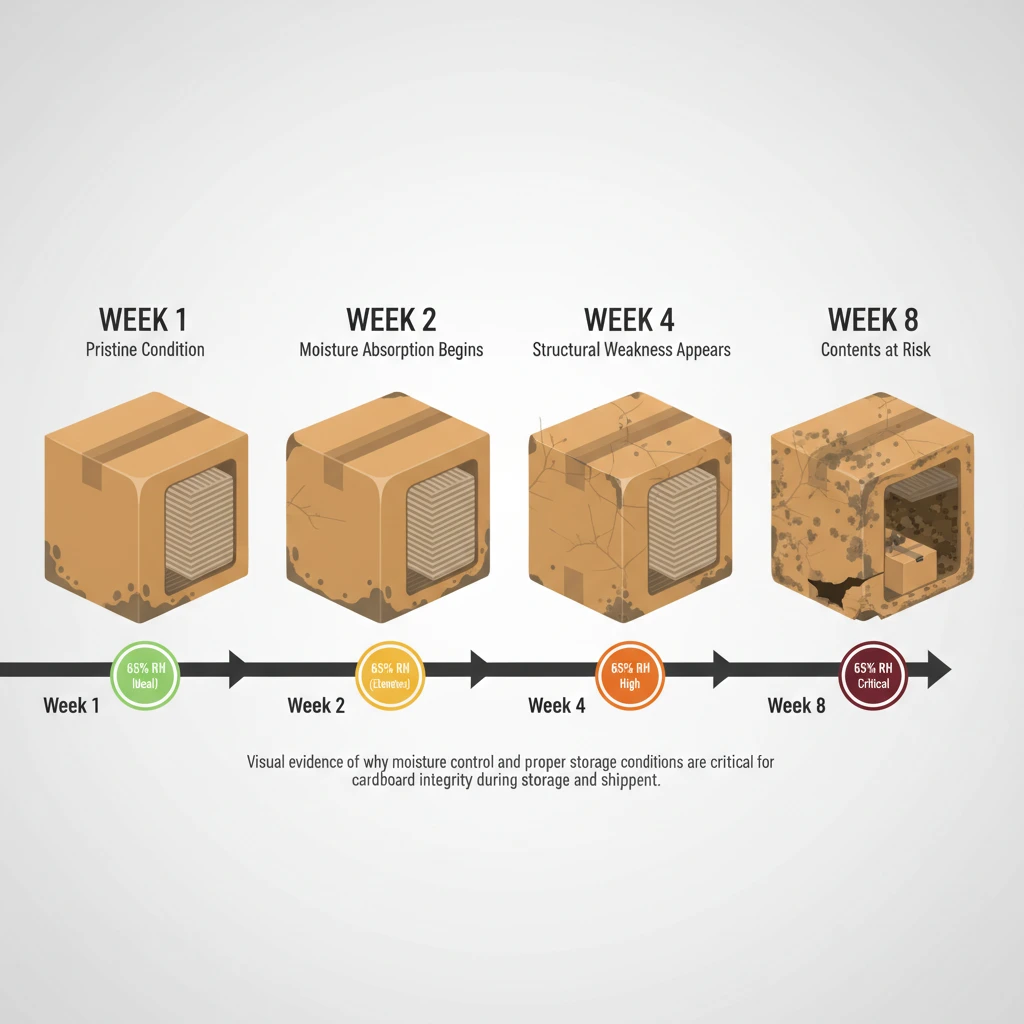
Moisture Sensitivity: This is the critical flaw. Cardboard absorbs water. In humid conditions, cardboard loses 5-15% of its stacking strength. In a Houston summer, this is devastating.
Limited Durability: Designed for single use or maybe two moves maximum. After that, they degrade, tear, and fail.
Water Damage Risk: Rain, spilled liquids, or high humidity can make cardboard soggy, compromise its structural integrity, and allow contents to fall through weakened bottoms.
Pest Vulnerability: Paper attracts insects and rodents. Cardboard provides no barrier against pest damage.
Loose Sealing: Tape-based sealing creates gaps that seal incompletely, allowing dust, insects, and moisture to infiltrate.
Stack Instability: Underweight, cardboard boxes can collapse, damaging contents and creating safety hazards.
Short Storage Life: Cardboard is a temporary solution. Extended storage (over 6 months) risks mold growth, structural failure, and damage to items.
Cardboard Box Lifespan
Under ideal conditions (dry, climate-controlled environment), cardboard boxes last:
- Single move: 100% success rate
- Two moves: 85% success rate (some deterioration visible)
- Three moves: 60% success rate (structural issues emerge)
- Storage, 6 months: 70% success rate (if dry)
- Storage, 1+ year: 40% success rate (moisture/mold risk)
Reality: Most cardboard boxes are single-use or, at best, serve two purposes before degradation becomes noticeable.
When Cardboard Boxes Make Sense
✓ Local, short-distance moves (under 100 miles)
✓ Immediate unpacking (within weeks)
✓ One-time household moves
✓ Budget-constrained situations
✓ Dry climate moves (not Houston summer)
✓ Temporary storage under 3 months
✓ Non-fragile, moisture-insensitive items
Understanding Plastic Storage Bins
Plastic storage bins represent a fundamentally different approach to storage containers. They prioritize durability, reusability, and protection over short-term cost savings.
The Advantages of Plastic Storage Bins
Durability: High-quality plastic bins last 5- 15+ years with regular use. Some polypropylene bins can last centuries. You’re making a long-term investment.
Water-Resistant: Fully waterproof design with sealed lids. Rain, humidity, and moisture cannot penetrate. Critical for Houston storage.
Stackable with Confidence: Rigid construction allows secure stacking with interlocking lids. Contents remain protected even when stacked 10+ boxes high.
Pest-Proof: Sealed plastic provides a complete barrier against insects, rodents, and other pests. Your stored items remain untouched.
See-Through Design: Many plastic storage bins feature clear plastic, allowing you to view contents without opening—critical for inventory management and finding items quickly.
Reusable Indefinitely: Use for multiple moves, seasonal storage, long-term storage, and organizational purposes. Each use amortizes the initial cost.
Low Maintenance: Plastic can be easily wiped clean, sanitized, and maintained. Unlike cardboard, it doesn’t absorb dirt or dust.
Secure Locking Lids: Protect valuable or sensitive items more reliably than taped cardboard.
Temperature Adaptability: Better resistance to temperature fluctuations than cardboard. Houston’s heat doesn’t degrade plastic as it does paper products.
The Drawbacks of Plastic Storage Bins
Higher Upfront Cost: $8-15 per bin vs. $2-5 for cardboard. Fifty bins cost $400-750 vs. $100-250 for cardboard.
Storage Space: Cannot collapse when empty. Full-sized bins take up storage space even when not in use.
Weight When Full: Loaded bins can weigh 30-40 pounds, making them physically demanding to move.
Limited Customization: Standard sizes and shapes. It cannot be easily modified like cardboard.
Cracking Risk: If dropped or mishandled heavily, plastic can crack. Cardboard just absorbs impact.
Extreme Temperature Degradation: Intense heat (140°F+) or extreme cold can degrade some plastic types. However, this is rarely an issue in normal usage.
Environmental Footprint (Initially): Higher production impact than cardboard. Takes 400 years to biodegrade if discarded.
Plastic Storage Bin Lifespan
Plastic storage bins’ durability timeline:
Normal Use (moves every 2-3 years, storage seasons):
- Year 1-5: 100% functionality
- Year 5-10: 95% functionality (minor cosmetic wear)
- Year 10-15: 85-90% functionality (lids may stiffen)
- Year 15+: Still usable, though lids may require replacement
Heavy Industrial Use: 5-7 years
Home Storage Use: 10-15 years
Premium Polypropylene Bins: 20+ years possible
Reality: Most home users get 10-15 years of excellent service from quality plastic bins.
When Plastic Storage Bins Make Sense
✓ Long-distance moves (100+ miles)
✓ Multiple moves planned (3+ times in 5 years)
✓ Long-term storage (6+ months)
✓ Humidity-prone climates (Houston, Southeast, coastal areas)
✓ Fragile or valuable items needing protection
✓ Items sensitive to moisture or pests
✓ Weather unpredictability
✓ Long-term organization and accessibility
Head-to-Head Comparison: Cardboard Boxes vs. Plastic Storage Bins
| Factor | Cardboard Boxes | Plastic Storage Bins |
| Cost Per Unit | $2-5 | $8-15 |
| Initial 50-Box Cost | $100-250 | $400-750 |
| Water Resistance | Poor (moisture destroys) | Excellent (fully waterproof) |
| Durability | 1-2 uses maximum | 5-15+ years |
| Stack Strength | Weakens under weight | Secure stacking capability |
| Pest Protection | None (attracts insects) | Complete seal against pests |
| Reusability | Single/double use | Unlimited reuses |
| Storage When Empty | Collapses to 90% smaller | Maintains full size |
| Weight Capacity | 40-50 lbs max | 50-60 lbs typical |
| Customization | Fully customizable | Limited standard sizes |
| Humidity Resistance | Fails in high humidity | Thrives in humidity |
| Climate Controlled Storage | Required for long-term | Not required |
| Cost Per Move (5 moves) | $250-500 | $80-150 amortized |
| Eco-Friendly Rating | Excellent (recyclable) | Good (reusable long-term) |
| Break-Even Point | N/A (typically single-use) | After 2-3 moves |
| Best For | Short-term local moves | Long-term/frequent moves |
The Humidity Factor: Why Houston Changes Everything
Houston presents a unique challenge for storage containers: extreme humidity and heat.
How Humidity Damages Cardboard Boxes
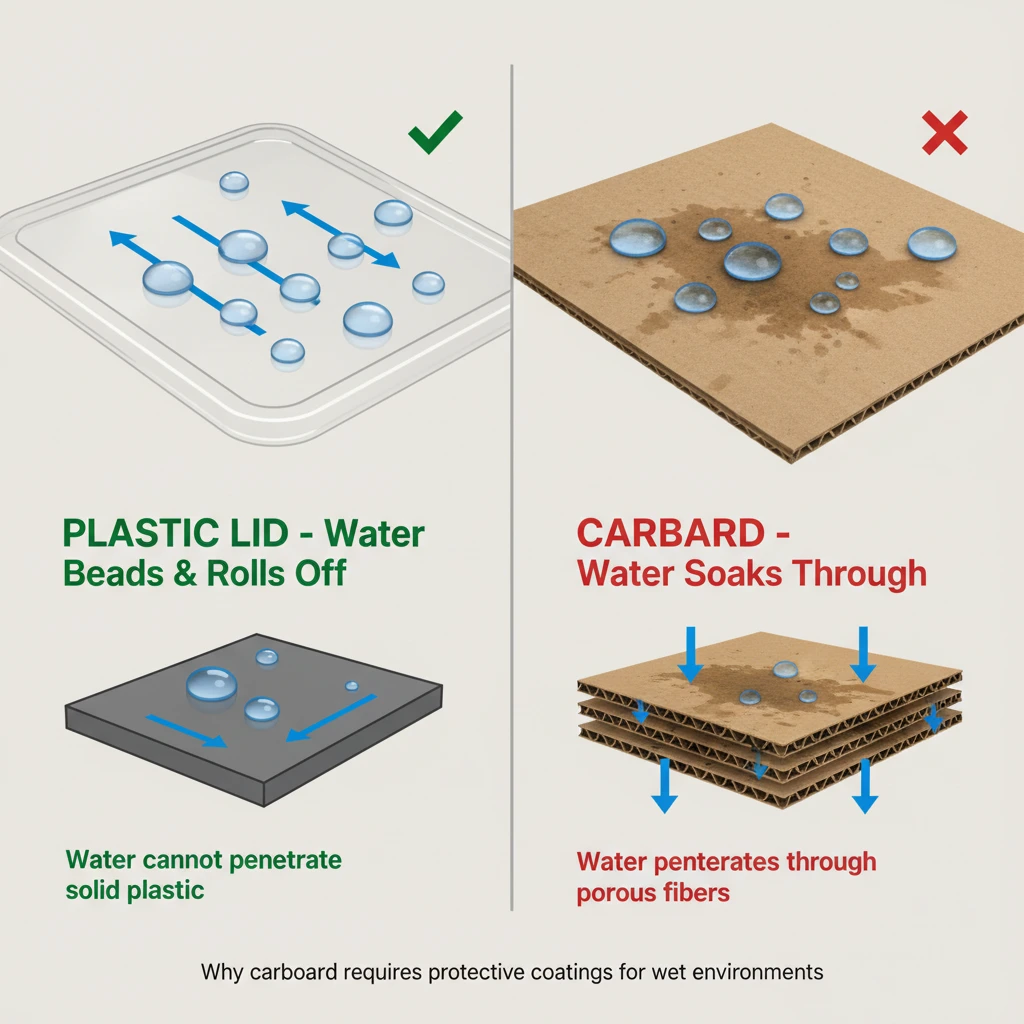
The Science: Cardboard is made from wood fibers bonded together. Water molecules are attracted to these fibers, causing them to absorb moisture and swell.
The Problem: When cardboard absorbs moisture:
- Structural integrity decreases 5-15%
- Stacking strength diminishes significantly
- Bottom corners become weak and can fail
- Mold begins growing inside boxes
- Contents become vulnerable to moisture damage
Houston’s Specific Challenge:
- Summer humidity: 65-75% (extremely high)
- Summer temperatures: 90-95°F+ (accelerates moisture absorption)
- Hurricane season: June-November (rain risk)
- Indoor storage is often uncontrolled (attics, garages)
- Coastal areas: Salt air accelerates deterioration
Real Impact: A cardboard box sturdy on moving day becomes noticeably weak within 2-3 weeks of Houston summer storage.
Why Plastic Bins Win in Humid Climates
Waterproof Sealing: Plastic is inherently moisture-resistant. Sealed lids prevent atmospheric humidity from affecting contents.
Non-Absorbent Material: Unlike cardboard, plastic doesn’t absorb water. Humidity cannot degrade its structure.
Mold Protection: Sealed plastic environment prevents mold growth. Cardboard boxes frequently develop mold in Houston’s humidity within months.
Long-Term Houston Storage: Items stored in plastic bins maintain integrity year after year. The same items in cardboard boxes deteriorate with the seasons.
Protection Strategy for Cardboard Boxes (if you must use them)
If budgets dictate using cardboard boxes in Houston, implement these protective measures:
Moisture Barriers: Line boxes with plastic sheeting or moisture-barrier liners. Reduces moisture penetration significantly.
Desiccant Packs: Place silica gel packets or charcoal briquettes inside boxes to absorb moisture.
Climate Control: Store in air-conditioned spaces, not attics or uncontrolled garages. This is the most effective strategy.
Ventilation: Keep storage areas well-ventilated to prevent humidity accumulation.
Elevation: Store boxes on pallets or shelves, not directly on the ground where moisture collects.
Regular Inspection: Check boxes monthly during the humid season for signs of moisture or mold. Replace damaged boxes immediately.
Reality Check: These protective measures add cost and effort. Plastic storage bins offer superior protection with minimal maintenance.
Cost Analysis: The Real Numbers
The upfront cost difference between moving boxes vs storage bins is noticeable. But the total cost of ownership tells a different story.
Scenario 1: One Local Move
Cardboard Boxes (50 boxes needed):
- Cost: $100-250
- Reuse potential: Single move only
- Total cost: $100-250
Plastic Storage Bins (50 bins):
- Cost: $400-750 (purchase)
- Rental alternative: $150-200/month
- Total cost: $150-200 (via rental) or $400-750 (purchase)
Winner: Cardboard for one-time local move
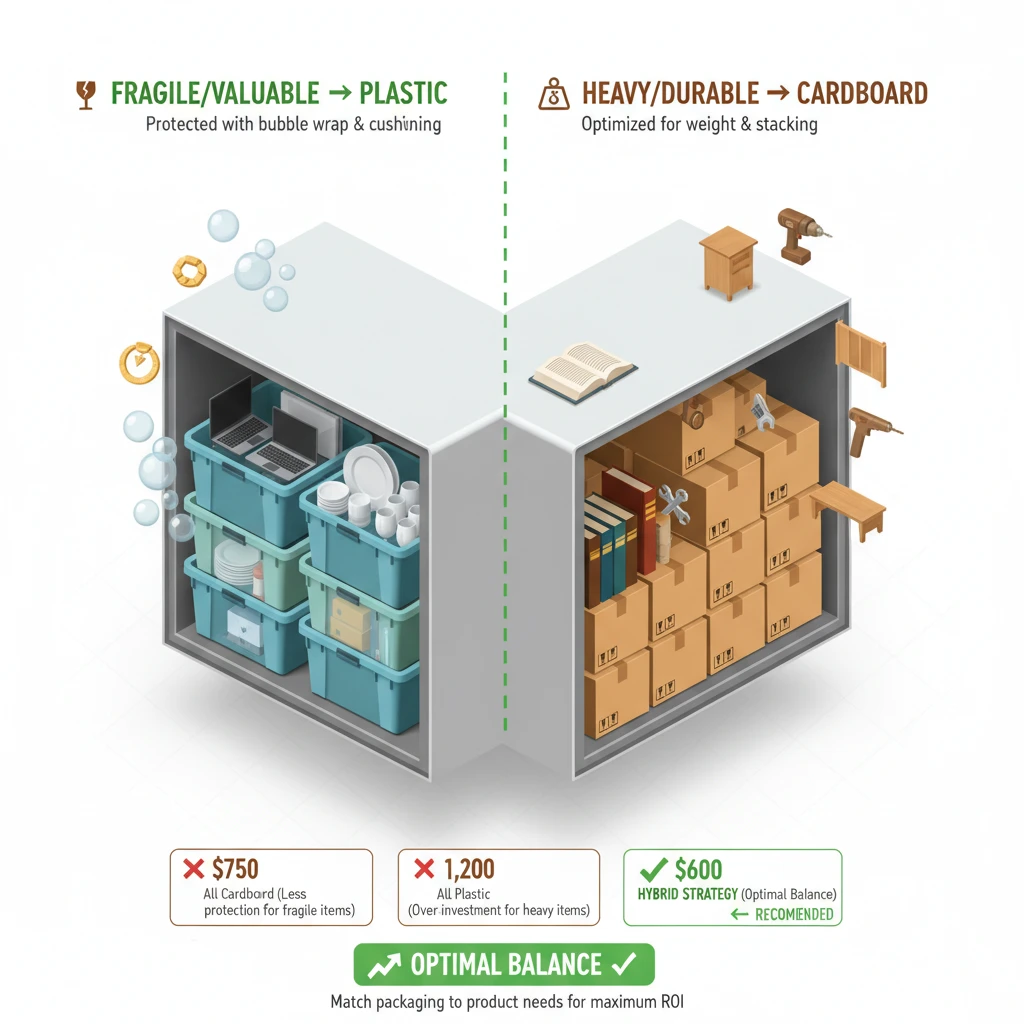
Scenario 2: Five Moves Over 10 Years
Cardboard Boxes (assuming 50 boxes per move):
- Move 1: $150
- Move 2: $150 (new boxes)
- Move 3: $150 (new boxes)
- Move 4: $150 (new boxes)
- Move 5: $150 (new boxes)
- Total cost: $750
Plastic Storage Bins (50 bins):
- Initial purchase: $500
- Replacement cost (year 7): $100 (a few lids)
- Total cost: $600
Winner: Plastic bins save $150 (20% savings)
Scenario 3: Long-Term Storage (3+ years)
Cardboard Boxes:
- Initial purchase: $150
- Replacement (year 1): $150 (moisture damage, mold)
- Replacement (year 2): $150 (deterioration)
- Replacement (year 3): $150 (structural failure)
- Total cost: $600 (plus content damage from moisture)
Plastic Storage Bins:
- Initial purchase: $500
- Maintenance (3 years): $0
- Replacement: $0 (still functioning excellently)
- Total cost: $500 (no content damage risk)
Winner: Plastic bins—saves $100 plus eliminates damage risk
5-Year Projection for Frequent Movers
For someone moving every 1-2 years (Gen Z/millennials):
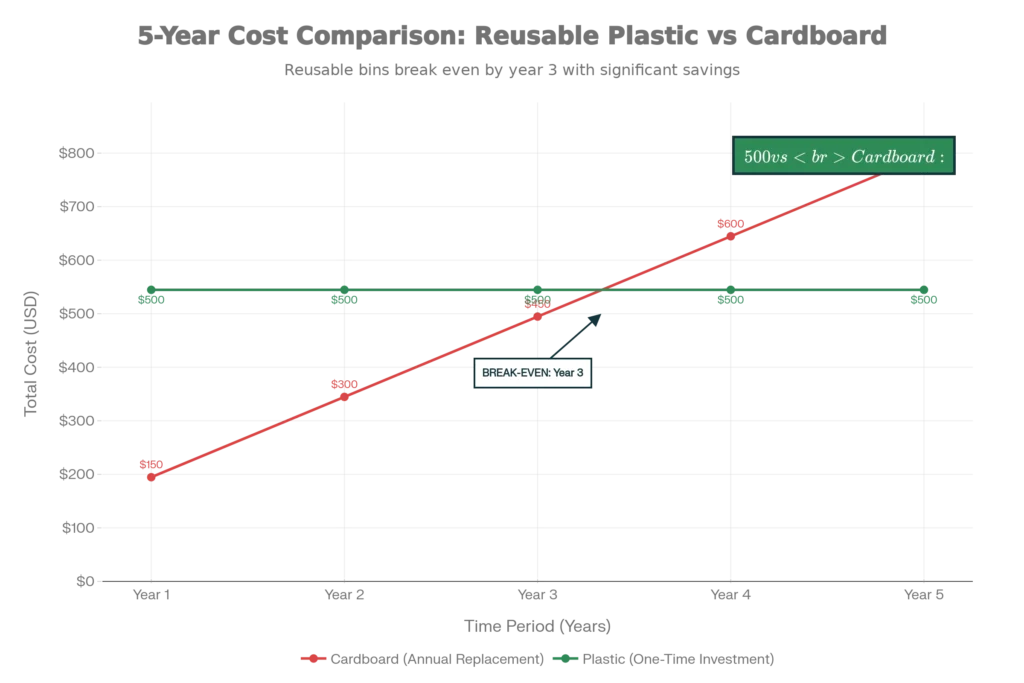
Cardboard: $250-300/year = $1,250-1,500 total
Plastic (one-time investment): $500 year 1, then $0 = $500 total
Savings with plastic: $750-1,000 (60-67% cost reduction)
Decision Framework: Which Should You Choose?
Use Cardboard Boxes If:
✓ Moving locally (under 100 miles)
✓ One-time move (not planning to relocate again soon)
✓ Budget is the primary constraint
✓ Climate is dry
✓ Immediate unpacking after move
✓ Short-term temporary storage (under 3 months)
✓ Non-sensitive items (basics, furniture)
✓ Moving outside of hurricane/wet season
Use Plastic Storage Bins If:
✓ Moving long-distance (100+ miles)
✓ Frequent mover (3+ moves in 5 years)
✓ Long-term storage (6+ months)
✓ Houston or humid climate location
✓ Valuable or fragile items
✓ Moisture-sensitive items (electronics, documents, clothing)
✓ Weather unpredictability
✓ Multiple storage periods needed
✓ Pest protection is important
✓ Organizing long-term
The Hybrid Approach: Smart Combination
Most practical strategy combines both:
Use Plastic Bins For:
- Fragile items (electronics, dishes)
- Valuable items (jewelry, documents, photos)
- Long-term storage items
- Items during the humid season storage
Use Cardboard Boxes For:
- Heavy items (books, tools, non-fragile)
- One-time moves
- Immediate unpacking needs
- Non-sensitive items
- Quick decluttering projects
Expected Outcome: Optimal protection with cost efficiency
Environmental Considerations: The Sustainability Question
Cardboard boxes vs plastic storage bins—which is truly more sustainable?
Cardboard’s Environmental Story
Positives:
- 100% recyclable—infinite recycling cycles possible
- Biodegradable—decomposes naturally
- Lower production energy (one-time manufacturing)
- Renewable resource (trees can be replanted)
Negatives:
- A single-use mindset creates landfill waste
- Recycling infrastructure required
- Transportation for recycling adds environmental cost
- Often ends up in landfills despite its recyclability
Sustainability Score: Good for one-time use; poor for frequent moves
Plastic’s Environmental Story
Negatives:
- Higher production footprint initially
- Takes 400 years to biodegrade if discarded
- Requires petroleum-based materials
Positives:
- Reusable 5-15+ times reduces manufacturing impact
- A long lifespan means fewer replacement items produced
- If reused 10 times, the environmental cost per use is 10x lower than cardboard
- Reduced waste through durability
Sustainability Score: Poor initially; excellent over 5-10 years of reuse
The Verdict
For one-time moves: Cardboard wins (recyclable, no waste)
For frequent movers: Plastic wins (less overall production/waste through reuse)
Houston Residents: Plastic wins (durability offsets production impact; cardboard creates waste through frequent replacement)
The most sustainable choice depends on your moving frequency and climate.
Common Mistakes When Choosing Moving Boxes vs. Storage Bins
Mistake #1: Choosing Based on Upfront Cost Alone
The Problem: Buying cheap cardboard boxes for multiple moves costs more than using reusable plastic in the long term.
The Solution: Calculate the total 5-year cost, not just the immediate cost.
Mistake #2: Ignoring Humidity in Houston Storage
The Problem: Assuming cardboard boxes will be fine “for a few months” in Houston’s summer. Moisture damage begins within weeks.
The Solution: For any Houston storage exceeding 3 months, choose plastic bins.
Mistake #3: Overestimating Cardboard Reusability
The Problem: Using damaged, moisture-compromised boxes for second move. Contents at risk.
The Solution: Inspect boxes before reuse. Replace any showing structural weakness.
Mistake #4: Buying Plastic Bins Without Considering Long-Term Use
The Problem: Purchasing premium plastic bins for one move, never using again.
The Solution: If moving only once, rent bins or use cardboard. Save plastic investment for frequent movers.
Mistake #5: Mixing Organization Standards
The Problem: Some items are in plastic bins with labels, others are in unlabeled cardboard—chaos during retrieval.
The Solution: Maintain consistent organization standards across all storage containers regardless of type.
Anchor Box Solutions: Your Moving and Storage Partner
Anchor Box provides both cardboard boxes and plastic storage bins for every moving and storage scenario.
For Moving Boxes: Our sturdy corrugated boxes are reinforced for long-distance reliability. We offer multiple sizes for different item types, ensuring optimal fit and protection during transit.
For Storage Bins: We stock quality plastic bins ideal for Houston’s humidity. Waterproof, stackable, and built to last—perfect for long-term storage or frequent relocations.
Right-Sizing Support: We help you calculate exact quantities needed, preventing both shortages and waste. No minimum purchase requirements means you buy exactly what you need.
Flexibility: Moving timeline changed? Storage duration extended? Our no-minimum policy allows you to adjust orders as situations evolve.
Fast Houston Delivery: Located in Houston, we provide rapid delivery for both boxes and bins, critical when moving timelines are tight.
Expert Guidance: Our team helps you decide between moving boxes vs storage bins based on your specific needs—distance, climate, storage duration, and budget.
FAQs
Are plastic storage bins worth the extra cost compared to cardboard boxes?
For one-time local moves, cardboard is more cost-effective. For multiple moves or long-term storage, plastic wins through reusability—saving 60-67% over 5 years despite higher upfront cost. In humid climates like Houston, plastic is worth the investment even for storage of more than 6 months.
How does Houston’s humidity specifically affect my choice between cardboard and plastic storage containers?
Houston’s 65-75% summer humidity causes cardboard boxes to lose 5-15% structural strength and develop mold within weeks. Plastic bins remain fully waterproof and mold-resistant. For any Houston storage over 3 months, plastic is strongly recommended to protect your items from moisture damage.
Can I use cardboard boxes if I add protective measures, such as moisture barriers and desiccant packs?
Yes, protective measures help, but plastic bins remain superior in humid climates. Moisture barriers add cost and effort without matching plastic’s inherent protection. For Houston long-term storage, invest in plastic containers rather than maintaining cardboard with constant protective measures.
How long do plastic storage bins actually last, and is their longevity worth the higher cost?
Quality plastic bins last 5-15 years with regular use. For frequent movers (3+ moves in 5 years), the cost per move averages $80-150 after amortization—cheaper than cardboard. For one-time moves, cardboard is more economical. Break-even occurs around move 2-3.
Should I use a hybrid approach with both cardboard boxes and plastic bins?
Absolutely. Use plastic bins for fragile/valuable items and anything stored long-term, and cardboard for heavy non-fragile items in immediate moves. This strategy optimizes both protection and cost efficiency, which is why professional movers increasingly use this approach.
Conclusion: Making Your Final Decision
Moving boxes vs storage bins—there’s no universal right answer. The correct choice depends on three factors:
- Moving frequency: One-time move? Use cardboard. Multiple moves planned? Plastic pays for itself.
- Storage duration: Under 3 months in a dry climate? Cardboard works. Longer storage or humid climate? Plastic is essential.
- Item sensitivity: Basic household items? Cardboard is fine. Fragile or valuable items? Plastic protects better.
For Houston residents specifically, plastic storage bins are the smart choice for anything beyond immediate unpacking, thanks to our unique humidity challenges.
Whether you choose cardboard boxes or plastic storage bins, prioritize protecting your belongings over saving pennies. Damaged items cost far more than the cost of quality containers.
Anchor Box offers both options with no minimum purchase, fast Houston delivery, and expert guidance to help you make the perfect choice for your specific situation.