


Choosing the wrong corrugated box strength isn’t just inefficient—it’s expensive. Either your products arrive damaged, or you’re spending money on packaging far stronger than needed.
According to recent industry data, companies implementing right-sizing strategies see a 40% reduction in packaging size and a 26% decrease in material consumption. But right-sizing starts with understanding what you’re buying.
Here’s the reality: most business owners can’t distinguish between A-flute and C-flute, don’t understand ECT ratings, and confuse burst strength with stacking strength. This knowledge gap leads to costly packaging mistakes.
In this comprehensive guide, we’ll demystify corrugated box specifications, explain wall thickness options, decode strength testing standards, and show you exactly how to select the perfect box for your products—every single time.
What is Corrugated Box Strength?
Corrugated box strength refers to a box’s ability to protect its contents during storage, handling, and shipping. But strength isn’t one-dimensional—it involves multiple factors working together.
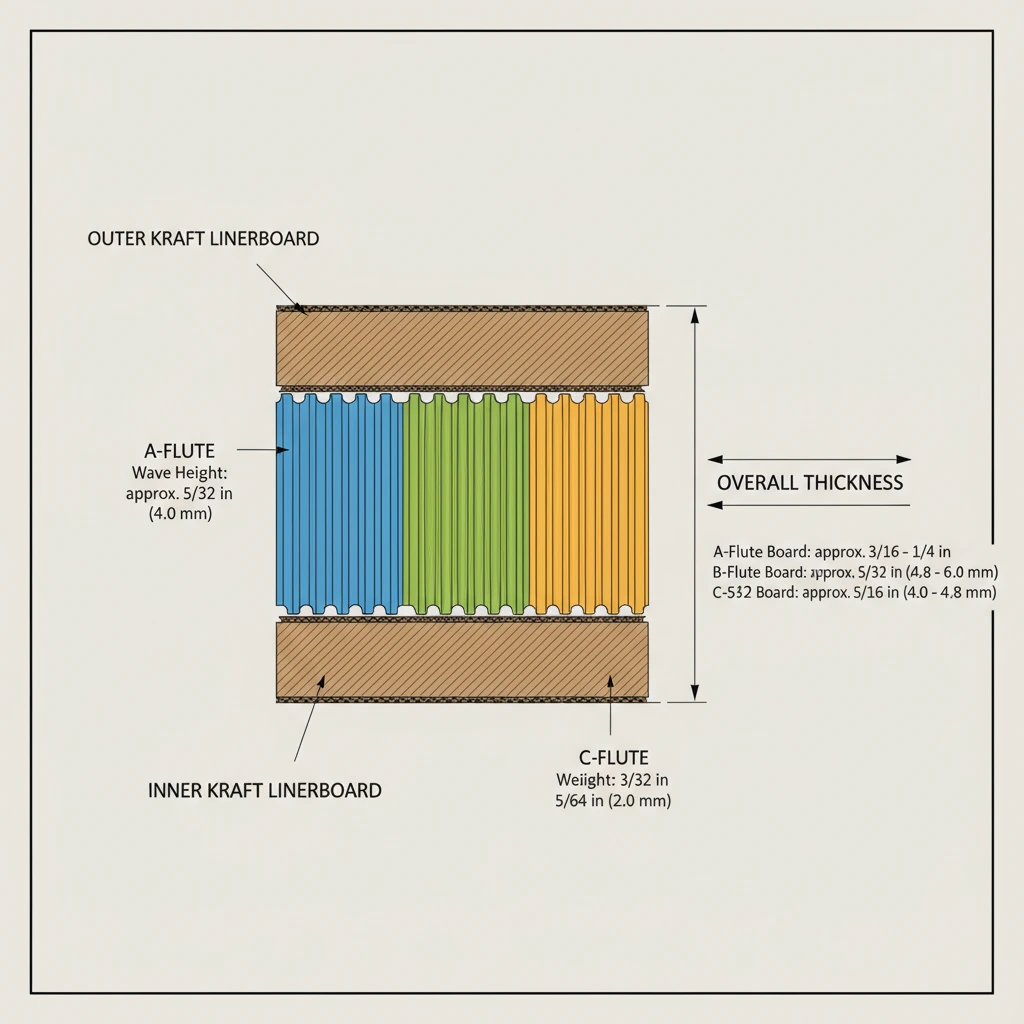
A corrugated box consists of three essential layers:
- Outer Linerboard: The thick paper visible on the outside
- Corrugated Medium: Wavy paper sandwiched between liners, providing cushioning
- Inner Linerboard: The inner protective layer
The wavy corrugated medium is the secret ingredient. This wave-shaped structure offers an exceptional strength-to-weight ratio, superior cushioning, and cost efficiency compared to solid cardboard.
Why this matters: The thickness, shape, and number of waves in the corrugated medium directly determine how much weight your box can hold, how effectively it cushions products, and how much stacking pressure it can withstand.
Understanding Corrugated Flute Types
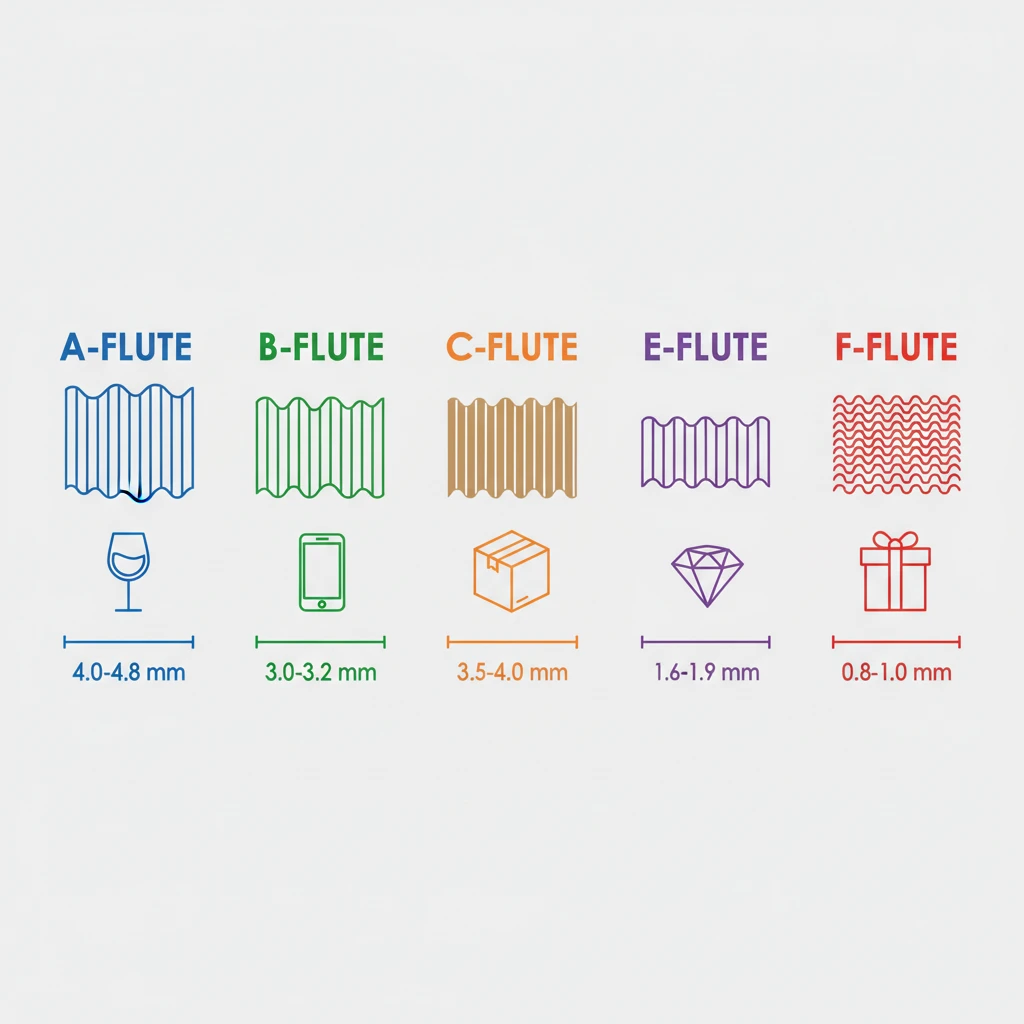
The term “flute” describes the wave-shaped corrugations in the middle layer. Different flute types offer different performance characteristics, and selecting the right one is crucial for packaging success.
A-Flute: Maximum Cushioning and Protection
A-Flute is the largest corrugation available with a height of 4.0-4.8mm and approximately 32-37 flutes per linear foot.
Key Characteristics:
- Exceptional cushioning properties
- Superior stacking strength (short column crush resistance)
- Excellent shock absorption during transit
- Thicker, more protective structure
Best Applications:
- Fragile electronics (TVs, monitors, audio equipment)
- Glassware and ceramics
- Heavy items requiring shock protection
- International shipping scenarios
- Long-distance transportation
Cost Consideration: Higher material cost due to increased corrugation height, but justified for high-value or delicate products.
B-Flute: Balance Between Strength and Space
B-Flute measures 2.5mm in height with 47-50 flutes per linear foot, offering a middle ground in packaging design.
Key Characteristics:
- Good puncture resistance
- Moderate stacking strength
- Compact profile saves storage space
- Slightly better printability than A-flute
- Efficient material usage
Best Applications:
- Small electronics (phones, tablets, chargers)
- Food and beverage packaging
- Cosmetics and beauty products
- Compact shipping needs
- Space-constrained warehouses
- Point-of-sale displays
Cost Advantage: More economical than A-flute while maintaining solid protection for moderate-weight items.
C-Flute: The Industry Standard
C-Flute is the market leader, accounting for approximately 80% of all corrugated boxes. It measures 3.2-4.0mm with 39-43 flutes per linear foot.
Key Characteristics:
- Perfect balance of protection, strength, and cost
- Excellent compression strength
- Good printing surface quality
- Optimal for general-purpose packaging
- Consistent industry standard
Best Applications:
- Shipping boxes for general merchandise
- E-commerce fulfillment
- Retail packaging
- Medium-weight products
- Standard warehouse storage
- Cost-conscious businesses need reliability
Industry Data: C-flute dominance stems from its proven track record of protecting products while maintaining cost-efficiency across diverse applications.
E-Flute: Smooth Surface and Premium Presentation
E-Flute provides fine corrugations at 1.0-1.8mm height with 94-96 flutes per linear foot, prioritizing printability and aesthetics.
Key Characteristics:
- Exceptionally smooth surface
- High-quality printing capabilities
- Refined, professional appearance
- Suitable for smaller, lighter items
- Enhanced shelf appeal
Best Applications:
- Cosmetics and luxury goods
- Small electronics and accessories
- Retail display packaging
- Custom branded boxes (higher print quality)
- Lightweight products requiring premium presentation
- Direct-to-consumer shipments emphasize the unboxing experience
Market Insight: E-flute popularity has grown with e-commerce expansion, as brands invest in memorable unboxing experiences.
F-Flute: Newest Innovation in Packaging
F-Flute represents the latest advancement in corrugated packaging, measuring just 0.8-1.0mm with 125-130 flutes per linear foot—the finest option available.
Key Characteristics:
- Thinnest corrugated option available
- Rigid box structure with reduced fiber content
- Superior printing quality
- Lowest material weight
- Growing adoption in North America
Best Applications:
- Luxury goods and high-end packaging
- Compact, lightweight products
- Subscription boxes
- Premium retail packaging
- Quick-service restaurant (QSR) packaging
- Environmentally-conscious businesses seeking material reduction
Emerging Trend: F-flute adoption is accelerating as companies balance sustainability goals with cost reduction.
Corrugated Wall Thickness: Single, Double, and Triple
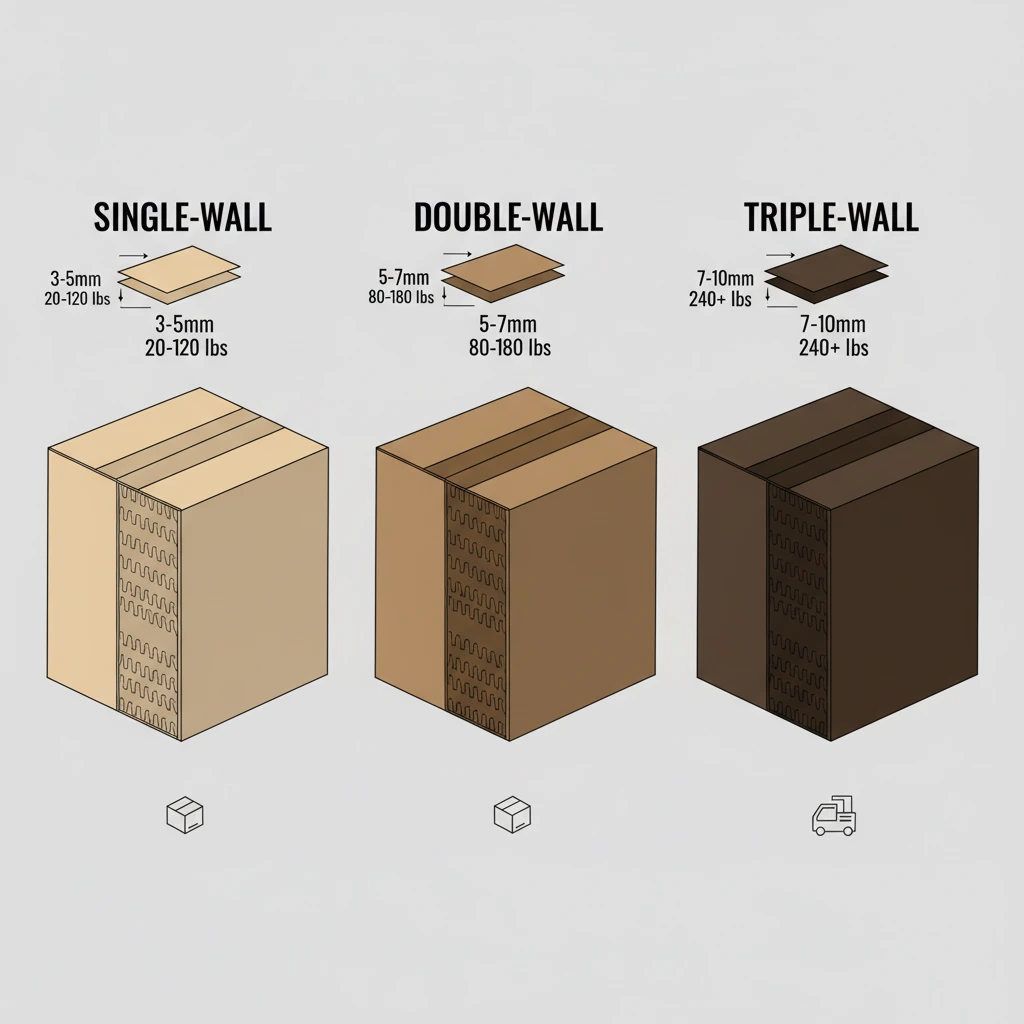
Beyond flute type, wall thickness refers to the number of corrugated layers in your box. Each layer dramatically changes the strength capacity.
Single-Wall Corrugated Boxes
Composition: One corrugated medium between two linerboards, totaling 3-5mm thickness.
Specifications:
- Weight Capacity: 20-120 pounds
- Cost: Most economical option
- Durability: Suitable for single shipping events or storage
Best For:
- Lightweight products (clothing, books, documents)
- Short-distance shipping
- Budget-conscious packaging needs
- Light office supplies
- Single-use applications
When to Choose Single-Wall: If your product weighs under 20 pounds and won’t experience extreme handling or stacking, single-wall boxes offer optimal cost-efficiency.
Double-Wall Corrugated Boxes
Composition: Two corrugated mediums between three linerboards, totaling 5-7mm thickness.
Specifications:
- Weight Capacity: 80-180 pounds
- Cost: Moderate—approximately 50-75% more than single-wall
- Durability: Excellent for demanding shipping and storage
- Stacking Capability: Multiple boxes can be safely stacked
Best For:
- Medium to heavy products
- Furniture and appliances
- Long-distance shipping
- Pallet stacking scenarios
- Multiple-handling situations
- Fragile items requiring extra protection
When to Choose Double-Wall: For products 40+ pounds or items requiring extra protection, double-wall provides confidence and protection, justifying the modest cost increase.
Triple-Wall Corrugated Boxes
Composition: Three corrugated mediums between four linerboards, totaling 7-10mm thickness.
Specifications:
- Weight Capacity: 240+ pounds
- Cost: Premium option—2-3x more than single-wall
- Durability: Maximum protection for extreme conditions
- Stacking Capability: Extensive palletized stacking support
Best For:
- Heavy industrial equipment
- Machinery and motors
- Automotive parts
- International ocean freight
- Heavy machinery requiring maximum protection
- High-value items in demanding environments
When to Choose Triple-Wall: For products exceeding 200 pounds or requiring the absolute maximum protection during extended shipping, triple-wall justifies the premium price.
Decoding Corrugated Box Strength Ratings
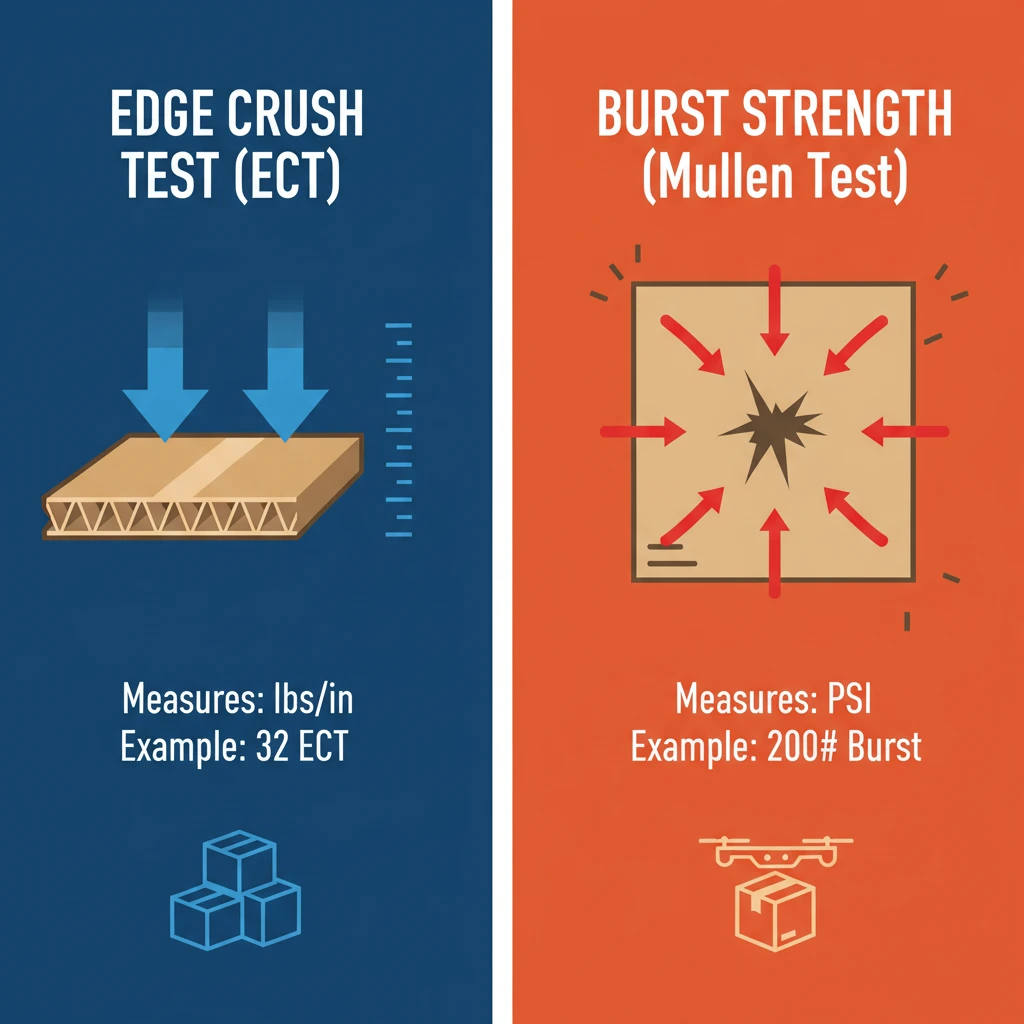
Understanding corrugated box strength ratings prevents costly packaging failures. There are two primary testing standards—and they measure completely different things.
Edge Crush Test (ECT): Stacking and Compression Strength
ECT measures vertical compression strength—how much weight your box can support when stacked with other boxes.
How ECT Testing Works:
- A small corrugated sample is placed between two compression plates
- Force is applied at a constant rate of 12.7mm per minute
- Testing continues until the sample collapses
- Results measured in pounds per linear inch (lbs/in)
ECT Rating Interpretation:
- 23 ECT = Boxes can hold approximately 20 pounds
- 26 ECT = Approximately 35 pounds capacity
- 29 ECT = Approximately 50 pounds capacity
- 32 ECT = Approximately 65 pounds capacity (industry standard)
- 44 ECT = Approximately 95 pounds capacity
- 55 ECT = Approximately 120 pounds capacity
When ECT Matters:
- Palletized shipping scenarios
- Warehouse stacking situations
- Multiple boxes stacked together
- Long-term storage where weight accumulates
Pro Tip: The 32 ECT and 200# Mullen rating combination represents the most common single-wall corrugated box specification, proven reliable across countless applications.
Burst Strength (Mullen Test): Puncture Resistance
Burst strength measures how well your box withstands punctures and ruptures—protection against sharp edges, irregular contents, or rough handling.
How Burst Testing Works:
- Force is applied to the face of the corrugated sample
- Testing measures resistance to puncture/rupture
- Results reported in pounds per square inch (PSI)
Common Burst Ratings:
- 125# Burst = Basic protection
- 150# Burst = Light protection
- 175# Burst = Moderate protection
- 200# Burst = Standard protection (most common)
- 275# Burst = Heavy-duty protection
- 350# Burst = Industrial-grade protection
When Burst Strength Matters:
- Individual parcel shipping (UPS, FedEx, USPS)
- Products with sharp edges or irregular shapes
- Contents creating internal pressure
- High-touch handling during transit
- Shipments through multiple distribution centers
Critical Distinction: Why 200# Burst ≠ 32 ECT
This is industry confusion point #1: These ratings are NOT interchangeable.
- 200# burst measures puncture resistance (how well it handles sharp objects)
- 32 ECT measures stacking strength (how much weight it supports vertically)
A box can have high ECT (excellent stacking) but lower burst strength if made from recycled fibers. Modern packaging increasingly reflects this reality, making both metrics essential to understand.
Decision Framework:
| Shipping Method | Prioritize This | Why |
| Individual parcels (USPS/UPS/FedEx) | Burst Strength | Sharp edges and rough handling are a priority |
| Palletized shipments | ECT Rating | Stacking weight matters most |
| Retail display boxes | Both equally | Need protection AND stacking capability |
| Fragile electronics | Burst Strength + Cushioning | Puncture risk from internal components |
| Heavy industrial goods | ECT Rating | Weight compression is the primary concern |
How to Choose the Right Corrugated Box Strength
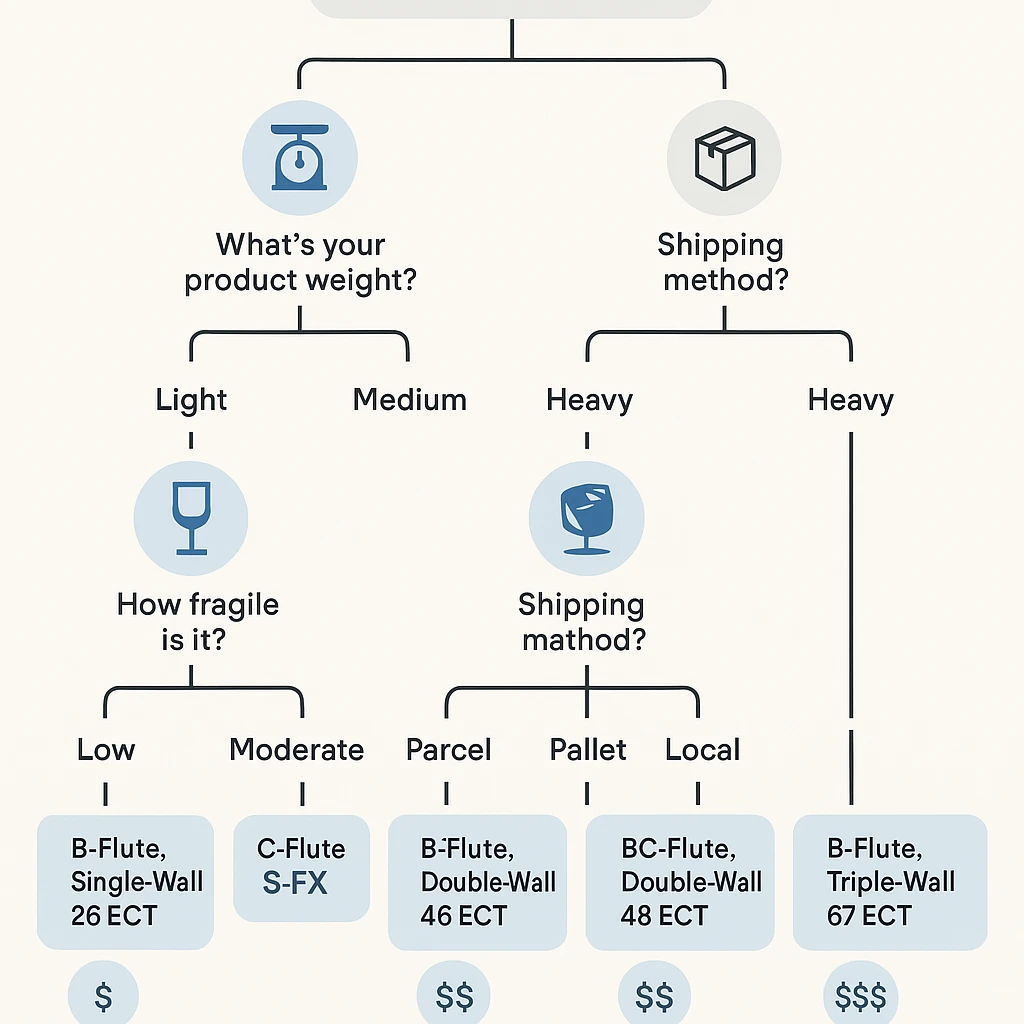
Selecting appropriate box strength requires evaluating multiple factors. Use this decision framework:
Step 1: Determine Your Product Weight
Start with the heaviest item you’ll package.
Weight Categories:
- 0-20 lbs: Single-wall possible; assess fragility
- 20-40 lbs: Single-wall recommended; confirm strength rating
- 40-80 lbs: Double-wall necessary
- 80-120 lbs: Double-wall required; consider triple-wall
- 120+ lbs: Triple-wall minimum
Step 2: Assess Product Fragility
Low Fragility (hard, durable products):
- Electronics components, plastics, metals
- Minimum ECT rating adequate
- Reduce wall thickness if weight permits
- Cost optimization possible
High Fragility (delicate, breakable items):
- Glass, ceramics, electronics
- Prioritize A-flute or B-flute for cushioning
- Double-wall minimum recommended
- Burst strength becomes critical
Moderate Fragility (standard products):
- Clothing, books, food, cosmetics
- C-flute standard sufficient
- Single or double-wall, based on weight
- Balanced approach appropriate
Step 3: Consider Your Shipping Method
Individual Parcel Shipping (UPS, FedEx, USPS):
- Choose boxes with adequate burst strength
- Priority: Puncture and rupture resistance
- Handle potential rough sorting and delivery
- 200# burst minimum recommended
Palletized/LTL Shipping:
- Focus on the ECT rating for stacking capability
- Will be stacked with other boxes
- 32 ECT minimum for standard loads
- 40+ ECT for heavy products
Local Delivery/Short Distance:
- Less handling reduces strength requirements
- Single-wall adequate for light products
- Cost reduction opportunity
- Burst strength is less critical
Step 4: Evaluate Storage Conditions
Warehouse Storage:
- Temperature and humidity stability
- High ECT if stacking multiple boxes
- 32-40 ECT typical
- Covered storage maintains strength
Outdoor/Variable Conditions:
- Moisture weakens corrugated material
- ECT decreases by 5-15% in high humidity
- Consider moisture barriers
- Double or triple-wall recommended
Long-Term Storage:
- Extended exposure degrades fibers
- Higher ECT provides a safety margin
- Protect from moisture and direct sunlight
- Consider storage location conditions
Step 5: Apply the Right-Sizing Principle
The Critical Insight: Oversized boxes cost more while providing no additional protection.
Right-Sizing Benefits:
- Reduces packaging material by up to 40%
- Lowers void fill requirements
- Decreases dimensional weight fees
- Improves warehouse efficiency
- Supports sustainability goals
Right-Sizing Approach:
- Measure your product precisely
- Allow 2 inches of height clearance for cushioning
- Select from standard box sizes when possible
- Avoid the “one size fits all” mentality
- Customize only when right-sizing isn’t available
Real-World Example: A business shipping 10,000 packages monthly can save $3,000-$5,000 annually by reducing the size of each box by just 20%.
Corrugated Box Applications by Product Type
Different products require different packaging approaches. Here’s guidance for common scenarios:
Electronics and Appliances
Requirements: Impact protection, moisture resistance, cushioning
Recommended Specifications:
- Small Electronics (phones, tablets): B-flute or C-flute, single-wall, 32 ECT minimum, 200# burst
- Large Appliances (refrigerators, washers): A-flute, double-wall minimum, 40+ ECT, 275# burst
- Fragile Components: A-flute, double-wall, 40+ ECT, moisture barriers
Packing Tips: A-flute provides superior cushioning for shock-sensitive electronics during transport.
Food and Beverage Packaging
Requirements: Moisture resistance, FDA compliance, product containment
Recommended Specifications:
- Dry Goods: C-flute, single-wall, 29 ECT, 175# burst
- Refrigerated Items: Wax-coated C or B-flute, double-wall, 32 ECT, 200# burst
- Heavy/Bulk Orders: Double-wall, 32+ ECT, 200# burst minimum
Compliance Note: Food-grade liners may affect strength slightly; verify with suppliers.
Cosmetics and Beauty Products
Requirements: Premium presentation, product protection, brand appeal
Recommended Specifications:
- High-End Luxury: E or F-flute, single-wall, 32 ECT, custom printing
- Standard Cosmetics: C-flute, single-wall, 26+ ECT, 200# burst, high-quality printing
- Bulk Orders: B or C-flute, single-wall, 29 ECT
Design Consideration: E and F-flute provide superior printing surfaces for brand differentiation.
Books, Media, and Stationery
Requirements: Weight capacity, stack ability, and an economical solution
Recommended Specifications:
- Standard Books: C-flute, single-wall, 32 ECT, 200# burst
- Heavy Book Orders: C or B-flute, double-wall, 40 ECT, 275# burst
- Office Supplies: B or C-flute, single-wall, 29+ ECT
Opportunity: Books represent high-weight products—double-wall often necessary despite single-item lightness due to quantity.
Fragile Items (Glass, Ceramics, Artwork)
Requirements: Superior cushioning, shock absorption, moisture protection
Recommended Specifications:
- Glassware: A-flute, double-wall, 40+ ECT, 275# burst
- Ceramics/Pottery: A-flute, double-wall, 40 ECT, 275# burst
- Fine Art/Framed Items: Triple-wall, 55+ ECT, 350# burst
Packing Critical: Box strength alone isn’t sufficient; interior cushioning (bubble wrap, foam corners) is essential.
Cost Efficiency Through Right-Sized Box Selection
Understanding the relationship between corrugated box strength and cost reveals significant optimization opportunities.
The Cost Escalation Principle
Each strength increase costs progressively more:
Single-Wall Pricing (Base = 100%):
- 23 ECT, 125# Burst: 100% (baseline)
- 26 ECT, 150# Burst: 105-110%
- 29 ECT, 175# Burst: 110-115%
- 32 ECT, 200# Burst: 115-125%
- 44 ECT, 275# Burst: 140-160%
- 55 ECT, 350# Burst: 180-220%
Double-Wall Pricing (vs. Single-Wall):
- Approximately 50-75% cost premium
- Justified for products over 40 pounds
- Necessary for fragile items requiring stacking
Triple-Wall Pricing (vs. Single-Wall):
- Approximately 200-300% cost premium
- Limited to heavy industrial applications
- Only justifiable for extreme requirements
Optimization Strategies
Strategy 1: Eliminate Unnecessary Strength
- Audit current box specifications
- Identify over-specification cases
- Downgrade where safety margins are excessive
- Potential savings: 10-25% annually
Strategy 2: Implement Right-Sizing
- Measure products precisely
- Select the smallest appropriate box
- Reduce void fill materials
- Typical savings: 20-40% annually
Strategy 3: Negotiate Volume Pricing
- Combine orders across box specifications
- Work with suppliers offering volume discounts
- Consider standardization across products
- Typical savings: 5-15% annually
Strategy 4: Explore Bulk Purchasing
- Purchase larger quantities during low-demand seasons
- Maintain appropriate inventory without excess
- Work with suppliers offering no-minimum policies
- Typical savings: 8-12% annually
Red Flags: Common Corrugated Box Mistakes
Avoid these costly packaging errors:
Mistake #1: Confusing ECT and Burst Strength
The Problem: Using the burst strength rating to determine stacking capacity results in box failure.
The Solution: Always clarify which test rating you’re discussing with suppliers; never assume interchangeability.
Mistake #2: Over-Specifying Strength
The Problem: Ordering 32 ECT boxes for 10-pound products is a waste of money with no benefit.
The Solution: Match strength ratings precisely to product requirements; avoid “standard” as a one-size-fits-all approach.
Mistake #3: Neglecting Humidity Effects
The Problem: Moisture reduces corrugated strength by 5-15%; boxes fail in humid conditions.
The Solution: Increase ECT rating by 10-15% for variable climate shipments; protect boxes from moisture.
Mistake #4: Ignoring Box Dimensions
The Problem: Oversized boxes increase material waste, shipping costs, and handling difficulty.
The Solution: Right-size boxes to product dimensions; calculate dimensional weight; select smaller boxes when feasible.
Mistake #5: Sacrificing Quality for Cost
The Problem: Ultra-cheap boxes from unreliable suppliers fail, resulting in damaged products and returns.
The Solution: Balance cost with reliability; verify supplier certifications; request samples before large orders.
FAQs
What’s the difference between single-wall, double-wall, and triple-wall corrugated boxes?
Single-wall boxes (3-5mm thick, 20-120 lbs capacity) are most economical for light products. Double-wall boxes (5-7mm thick, 80-180 lbs capacity) cost 50-75% more but provide extra protection for fragile or heavy items. Triple-wall boxes (7-10mm thick, 240+ lbs capacity) are premium options for industrial applications. Choose single-wall for products under 40 pounds, double-wall for 40-80 pounds, and triple-wall for anything exceeding 120 pounds.
Should I prioritize ECT or burst strength for my shipments?
Prioritize ECT rating for palletized/stacking scenarios where boxes compress vertically, and burst strength for individual parcel shipping (USPS, UPS, FedEx) where puncture risk is higher. For retail displays, balance both equally. Match ratings to your specific shipping method—never assume one eliminates the need for the other.
What does “32 ECT” actually mean, and how much weight can it hold?
32 ECT (Edge Crush Test) means the corrugated sample withstands 32 pounds of crushing force per linear inch of width. A box with 32 ECT can safely hold approximately 65 pounds of product weight in single-wall construction. Double-wall boxes with 32 ECT hold significantly more. This is critical in warehouse stacking scenarios where multiple boxes compress vertically.
Can I use smaller, cheaper boxes to reduce shipping costs?
Yes—right-sizing boxes to your product dimensions can save 20-40% on packaging costs annually. Measure precisely, select the smallest box with 2 inches of clearance for cushioning, and calculate dimensional weight (carriers sometimes charge by size, not just weight). Don’t sacrifice protection to save pennies; a damaged $50 product costs far more than the cost of optimal box protection.
How do humidity and climate affect corrugated box strength?
High humidity (60%+) reduces ECT and burst strength by 5-15% as corrugated fibers absorb moisture and weaken. For humid, tropical, or ocean freight scenarios, increase your ECT rating by 10-15% as insurance. Use moisture-barrier liners and desiccant packets for unpredictable climates. Protect boxes from direct moisture exposure during storage and transit to maintain strength ratings.
Conclusion: Making Your Box Selection Decision
Understanding corrugated box strength empowers you to make wise packaging decisions that protect products while optimizing costs.
Key Takeaways:
✓ C-Flute dominates the market for good reason—it balances strength, cost, and versatility
✓ Match strength to requirements—overspecifying wastes money; underspecifying risks product damage
✓ ECT and Burst Strength measure different things—never assume they’re interchangeable
✓ Right-sizing delivers wins—optimal box size reduces costs AND improves efficiency
✓ Humidity matters—increase strength ratings 10-15% for humid or variable-climate shipments
Your Next Step:
Audit your current box specifications against product weights and shipping methods. You may discover opportunities to optimize costs without sacrificing protection.
For personalized guidance matching your specific products to ideal box specifications, Anchor Box offers free consultations with packaging specialists. No minimum orders required—we work with businesses of all sizes to find the perfect box solution.

we are proud to offer our customers high-quality Wolf Grill and BBQ repair services. Our team of experienced and certified technicians are ready to help you with any repair needs you may have, big or small